Select the Sequence Sound node in the project tree to show the sequence sounds in the Sound Set tab.
The list displayed here is called the Sequence Sound List.
To create or add a Sequence Sound, select the list region in the Sound Set tab and then select Project → Add Item → Sequence Sounds.
You can also create or add a sequence sound by right-clicking the Sequence Sound List and using the shortcut menu that displays.
Sequence sounds are edited from the Sequence Sound List.
The columns in the Sequence Sound List show the defined elements that are essential to the sequence sound. These correspond to the elements that are essential for the sequence sound data in the Sound archive.
This section explains the meanings of the various defined elements in the Sequence Sound List.
Clicking this button will register the selected sound in the Preview Player window, and will trigger playback of the sequence sound.
Specifies the name of a sequence sound. Programs use this name to play the sequence sound through the snd library from the sound archive that is ultimately created.
There are restrictions on the characters that can be used in a name. The following characters can be used.
- The first character must be a single-byte letter or an underscore. [a-zA-Z_]
- Other characters must be single-byte alphanumeric or an underscore. [a-zA-Z0-9_]
Select the type of reference file. Select SMF when using a standard MIDI file, and Text (text in the dialog box) when using a text sequence file.
Specifies the file to reference when creating a sequence sound.
There are restrictions on the characters that can be used in a file name or path name. The following characters can be used.
- The first character of a file name must be a single-byte letter or an underscore. [a-zA-Z_]
- Other characters in a file name must be single-byte alphanumeric or an underscore. [a-zA-Z0-9_]
When using a text sequence file as a reference file, the sequence label that will play in the sequence sound is specified.
If this specification is not given, the very first sequence in the text sequence file plays.
Specifies the bank to use when playing a sequence sound.
Specifies the player to use when voicing a sequence sound.
Specifies the volume (from 0 to 255) to use when the snd library plays the sequence sound.
If sound data volume is set to 127, playback is made at an equal volume (x1) as source data.
However, volume can be set in various ways (data or program).
The result after all setting values are applied is clamped between 0.0x and 2.0x versus the source volume.
For more details, see the chapter Operating Sound Parameter Controls in the Sound System Manual.
Specifies the channel priority of the sequence sound as a value from 0 through 127. The higher the value, the higher the priority.
This value gets added in the sequence file that is being referenced to the sound priority that has been set for each channel. The result becomes the final sound priority for each voice when it sounds.
To learn how to set the sound priority for the sequence file, see the Sequence Data Manual ($SoundMaker/docs/SequenceData_Manual.pdf).
Specifies the player priority of the sequence sound as a value from 0 through 127. The higher the value, the higher the priority.
Player Priority selects which sounds to play (or stop) when the Player attempts to play more than its sound limit, or more than the maximum number of sounds and tracks as configured in the system settings.
For details, see the Sound System Manual.
The values 0 through 3 represent the four types of actor players to be played.
Because actor players correspond to a real-world sound source or, specifically, the vocal chords of a certain voice, it is possible to limit the number of sounds that can be played at the same time for each actor player.
Just as with a player, if the set number of sounds is exceeded, the player priority set for each sound is compared, and the sound with the lowest priority is stopped. The initial value of the number of restricted sounds for each actor player is unlimited for actor player number 0, and 1 for all other actor player numbers 1 through 3.
Actor players are mainly used in conjunction with 3D sound actors. As an example, this is useful when you want to suppress the playback of a sound at the actor level in situations where the same sound might be played simultaneously by multiple 3D sound actors.
If this option has been checked, the voice priority of the corresponding sound is not reduced even during release.
Sets whether 3D sound volume control is applied.
3D sound volume control for sounds can be disabled by removing this check.
Sets whether 3D sound pan control is applied.
3D sound pan control for sounds can be disabled by removing this check.
Sets whether 3D sound surround pan control is applied.
Clear this check box to disable 3D sound surround pan control for sounds.
Sets whether 3D sound voice priority control is applied.
Clear this check box to disable 3D sound voice priority control for sounds.
Sets whether 3D sound Biquad filter control is applied.
Check this item to enable 3D sound Biquad filter controls for sounds.
Selects the volume decay system to be applied to 3D sounds.
Selects the volume decay ratio to be applied to 3D sounds.
Sets the Doppler effect to be performed by the 3D sound.
Sets the pitch variation to be used by the Doppler effect as a value from 0 through 255.
The default value is 0. The larger the value, the greater the change in pitch, while a value of 0 represents absolutely no change in pitch.
Sets whether to use the front bypass setting for 3D Surround.
When this check box is selected, the mode becomes Front Bypass mode.
In Front Bypass mode, the front L/R audio plays from the locations of the physical speakers.
In normal 3D Surround, the front L/R audio plays from the locations of the virtual speakers (which are wider than the physical speakers)
Configures the 32-bit numerical value that the user is free to set.
Multibanks can be specified when working with sequence sounds.
Up to four banks can be set for a single sequence sound.
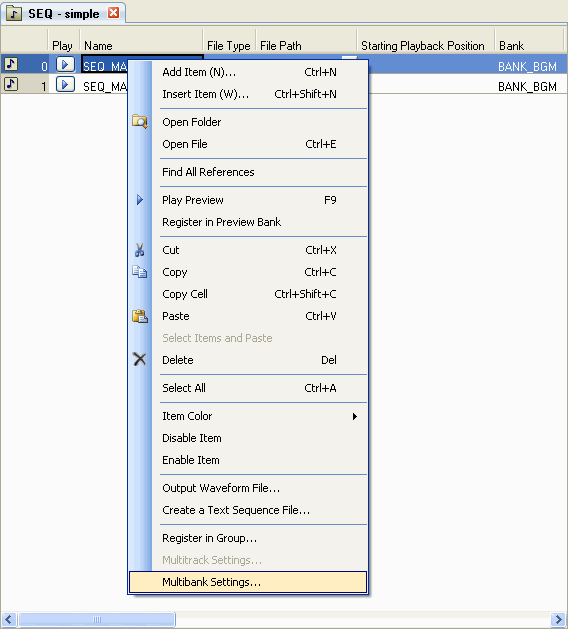
Right-click a sound you want to configure within the sequence sound list, then select Multibank Settings... from the shortcut menu that appears.
Add banks by clicking the Add button.
To delete a bank setting, select an item within the list, then click the Delete button.
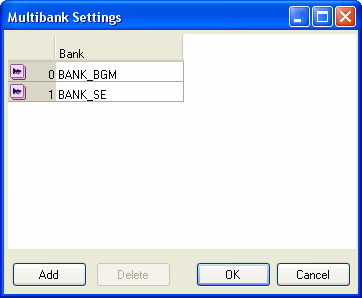
An asterisk ( * ) will be displayed in the Bank column for sequence sounds for which multiple banks have been specified. When multiple banks have been specified for a given sequence sound, the bank cannot be changed directly from the sequence sound list.
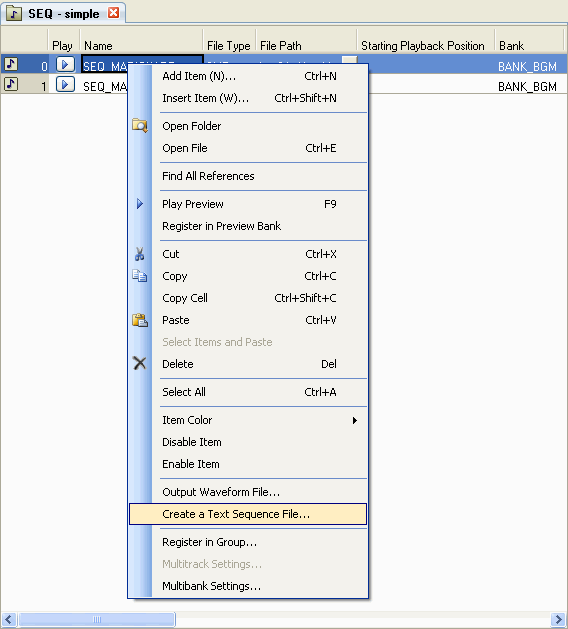
You can create a text sequence file (.cseq) from the converted SMF file.
Use these features to create and edit text sequences.
Right-click on the sequence sound list to open the context menu and select Convert SMF File.
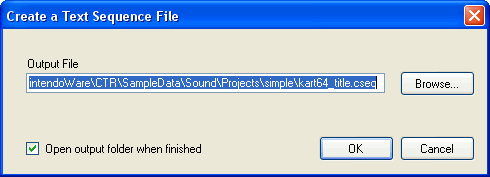
A dialog opens to specify an output location, so set this together with a filename to create the text sequence file.
CONFIDENTIAL