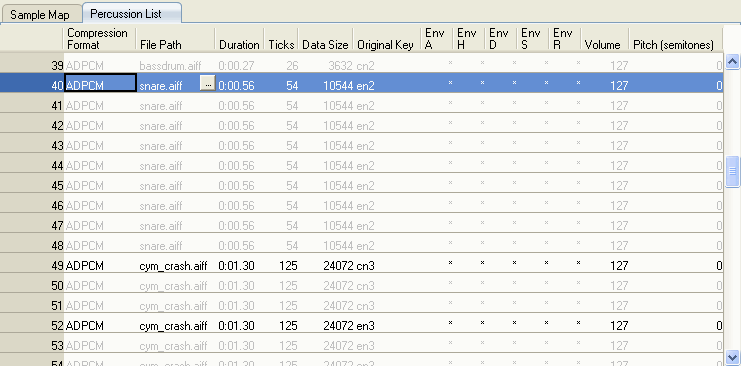
The Bank tab is divided into upper and lower sections for display. The upper part is the Instrument List. Tabs for the Sample Map and Percussion List appear in the lower part. The Percussion List appears in the lower part when the Percussion List tab is selected.
The Percussion List is a special editor for editing instruments.
It edits instruments selected on the Instrument List.
Although the Percussion List is an editor for multi-region instruments just as the Sample Map, in contrast to the Sample Map, the Percussion List displays a keyboard laid out vertically. Compared to the Sample Map, the Percussion List is used to create percussion-type instruments where there are many cases of creating a lot of small key maps in a very limited range.
Velocity regions cannot be handled in the Percussion List.
This section describes the operations possible with the Percussion List.
To create key regions, right-click the list and select Divide Key Region from the shortcut menu that appears. The Percussion List corresponds to a keyboard, with notes listed in order starting from low notes to high notes. The created key region extends downward in the list from the row where the division operation was performed to the higher note where the next key region starts.
Velocity regions cannot be created in the Percussion List.
Right-click to open the shortcut menu and select either Open Folder or Open Reference File to perform various operations on the specific files.
This section describes the meaning of each of the elements that defines a Percussion List.
Specifies the compression method to use when converting reference waveform files.
Specifies the waveform file that the region will reference.
There are restrictions on the characters that can be used in a file name or path name. The following characters can be used.
- The first character of a file name must be a single-byte letter or an underscore. [a-zA-Z_]
- Other characters in a file name must be single-byte alphanumeric or an underscore. [a-zA-Z0-9_]
Displays the playback time for sounds (the length of the waveform data expressed as time).
The units are displayed in the "m:s.ms" format. The milliseconds are rounded up to the nearest two decimal places.
Displays the length of the required node commands.
Ticks are units for specifying the length of the notes and rests within text sequences.
The number of ticks per minute and second will depend on both the tempo and the quarter note resolution, but if we assume the default tempo value of 120 qpm (quarter notes per minute), and we assume that the quarter note resolution of the text sequence is set at the default value of 48 (this is different than the value that is set in the SMF Quarter Note Resolution field under Project Settings, they can be calculated as follows:
Knowing the number of ticks is useful when writing text sequences.
Note that changing the pitch of an instrument will cause the actual playback duration to increase or decrease, and the number of actual ticks taken for playback will change accordingly.
Shows the size of the waveform data after compression conversion.
If multiple waveform files are referenced, as in the case of multi-region instruments, the sum total size of the reference files is shown.
The content on display is updated when files are converted.
Specifies the original key for the region.
Envelopes can be set either per instrument or per region.
See Instrument Parameters for an explanation of envelopes.
Only in the case of multi-region instruments, an envelope attack time of 0 to 127 is specified for the region.
The same is true for each phase of envelope specifications given below.
Specifies the envelope hold time as a value from 0 to 127.
Specifies the envelope decay time as a value from 0 to 127.
Specifies the envelope sustain level as a value from 0 to 127.
Specifies the envelope release time as a value from 0 to 127.
Specifies the region volume as a value from 0 through 255.
If sound data volume is set to 127, playback is made at an equal volume (x1) as source data.
However, volume can be set in various ways (data or program).
The result after all setting values are applied is clamped between 0.0x and 2.0x versus the source volume.
For more details, see the chapter Operating Sound Parameter Controls in the Sound System Manual.
Specifies the region's pitch in units of half-tones.
Specifies the region's pitch in units of cents (1 cent = 1/100th of a half-tone).
Specifies the pan for the region.
Specifies the percussion mode for the region.
When checked, it indicates that percussion mode is enabled.
In regions where percussion mode has been specified, the note-off command is ignored, and the wave file is played to the end regardless of the note length.
The pitch calculation corresponding to the note height is carried out as usual.
Take care when applying to regions for which a looping wave file has been set.
Specifies the key group for a region as a value from 0 through 15.
Operations are not performed for the key group when 0 has been specified. Zero is set as the key group default.
In regions where the same nonzero key group has been set, each time a new note plays, playback of whatever is currently being played for the same key group stops.
This feature allows emulation of such effects as closed high hat and open high hat.
Key group operations are only enabled within the same track of a sequence.
In cases such as using the same instrument from multiple sequences, or using the same instrument at the same time from multiple tracks within a sequence, the key group feature cannot be used.
Specifies the interpolation type for instruments.
Configure the voice interpolation method and select either 4-point interpolation, Linear interpolation or No interpolation.
The default value is 4-point interpolation (INTERPOLATION_TYPE_POLYPHASE).
In the descriptions below, the interpolation algorithm used when converting the sampling rate is configured and obtained in the application using the nn::snd::Voice::SetInterpolationType function and the nn::snd::Voice::GetInterpolationType function.
CONFIDENTIAL